When Politics Finds Religion
I started by wondering when faith became political. I ended up asking a much more uncomfortable question: What happens when politics begins shaping our faith?
THINGS I NEED TO UNDERSTAND • SEPTEMBER 18, 2026
A section where I take something I realized I did not understand well enough, learn it properly, and share what I found.
◆
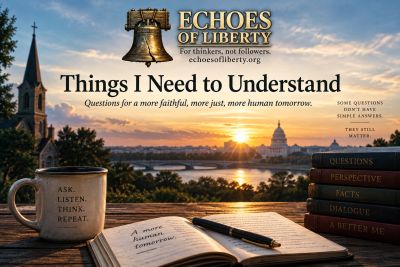
I grew up Catholic. Religion was part of the landscape of my childhood—the Mass, the prayers, the stories, the rules, the questions. Politics was there too, although I seem to remember being told that religion and politics were the two subjects polite people weren't supposed to discuss at dinner.
I've never been completely convinced they can be separated. If you genuinely believe something about right and wrong, about the value of human life, about our obligations to one another, those beliefs are going to follow you into the voting booth.
They probably should.
If I believe we have an obligation to care for people who are suffering, that will affect how I think about poverty. If I believe human life has inherent value, that will affect how I think about abortion, war, capital punishment and violence. If I believe I should welcome the stranger, that will complicate the way I think about immigration. And if I believe government has a responsibility to protect its citizens, that will complicate some of those things all over again.
That's not hypocrisy. That's the difficult work of translating moral conviction into public policy.
But lately I've been wondering about something else. What happens when the traffic starts moving in the other direction? What happens when politics begins shaping our faith?
I didn't know. So I went looking.
The Question I Started With Was Wrong
My original question was simple: When did faith become political in America? It didn't survive very long.
Faith has been political in America almost from the beginning. Christians appealed to Scripture in the struggle to abolish slavery. Other Christians appealed to Scripture to defend slavery.
Black churches became indispensable institutions in the civil-rights movement. Martin Luther King Jr. wasn't merely a political organizer who happened to attend church. He was a Baptist minister whose theology helped shape his understanding of justice.
Other churches defended segregation. Still others stayed quiet.
Christians have marched against wars and prayed over soldiers leaving for them. They have organized movements for the poor and movements against abortion. They have advocated for immigrants and refugees and argued for borders and national security. Sometimes they have done these things while reading the same Bible.
That history makes it hard to argue that faith should simply stay out of politics. Would we really have wanted the abolitionist's Christianity kept private? Should King's faith have remained safely inside Ebenezer Baptist Church?
If a person's deepest convictions about human dignity disappear the moment public policy enters the conversation, I'm not sure how deep those convictions were in the first place.
The question wasn't when faith became political. The question was what happens when politics becomes religious.
Something Strange Happens When Identity Enters the Room
Religion and partisan identity are remarkably intertwined in America today. Pew Research Center's 2023–24 Religious Landscape Study found that 70 percent of evangelical Protestants identify with or lean toward the Republican Party. Among historically Black Protestants, 72 percent identify with or lean Democratic.
White Catholics lean Republican. Hispanic Catholics lean Democratic. And among Black Americans, Pew found that Democratic identification remains predominant regardless of how religious they are.
Same country. Often the same Bible. Same Jesus. Very different politics.
That tells me something important. Christianity by itself doesn't hand somebody a ballot with the correct boxes already marked. Something else is happening between Scripture and the voting booth.
History enters.
Race enters.
Culture enters.
Economics enters.
Family enters.
Fear enters.
Experience enters.
And politics enters.
That's when I started wondering whether we sometimes reverse the relationship without realizing we've done it. Instead of asking our faith what it demands of our politics, perhaps we begin asking our politics what it needs from our faith. And once I started looking at the question that way, I kept running into a phrase that has become increasingly difficult to avoid.
Christian nationalism.
What Are We Actually Talking About?
The phrase gets thrown around so casually that it can mean almost nothing. Sometimes it seems to mean conservative Christian. Sometimes it means Republican who goes to church. Sometimes it is used as an accusation. Sometimes people embrace the label themselves.
None of that tells me much. So before deciding what I thought about Christian nationalism, I needed to understand what researchers actually mean by it.
The Public Religion Research Institute measures Christian nationalism through five questions about Christianity, government and American identity—including whether the federal government should declare America a Christian nation, whether being Christian is an important part of being “truly American,” and whether U.S. laws should be based on Christian values.
That's more specific than patriotism. Loving your country isn't Christian nationalism. Neither is praying for it. Neither is believing that your Christian convictions should influence your vote.
Christian nationalism describes a particular merging of Christian identity, national identity and political authority.
And it matters.
PRRI's 2025 American Values Atlas, based on more than 22,000 interviews, classified 11 percent of Americans as Christian-nationalism “Adherents” and another 21 percent as “Sympathizers.” Among White evangelical Protestants—a narrower group than the evangelical Protestants in the Pew figure above—the combined number was 67 percent. Among Republicans, 21 percent were classified as Adherents and 35 percent as Sympathizers—a combined 56 percent.
Those numbers are substantial. But numbers still don't tell me whether the ideas are right or wrong. For that, I needed to understand the argument.
The Argument Deserves to Be Heard
There is a version of the Christian-nationalist argument that is easy to ridicule. I'm not interested in that version.
The more serious argument goes something like this: Every nation builds its laws on moral assumptions. American culture was profoundly influenced by Christianity.
Government has obligations that individuals do not. A Christian can personally love an enemy while still believing government must protect innocent people from that enemy. Welcoming the stranger does not necessarily mean a nation cannot maintain a border. Mercy does not eliminate justice.
And Christianity cannot be reduced to the sayings of Jesus printed in red ink. The Bible contains much more than four Gospels.
Those are legitimate arguments. In fact, some of them strike me as plainly true. If someone attacks the United States, “turn the other cheek” isn't much of a military doctrine. If someone crosses a border illegally, saying “welcome the stranger” doesn't by itself tell Congress what immigration law should be.
Public policy is complicated. But accepting that complexity doesn't end my question. It makes the question better.
Where does legitimate Christian influence on public policy end...
and the use of Christianity to sanctify political power begin?
So I Went Back to the Red Letters
I'm not a theologian. I'm certainly not qualified to decide who is and isn't a “real Christian.” But Christianity gives me an unusually direct place to begin examining the question: the words attributed to Jesus in the Gospels. In the Bible I grew up with, some of them were printed in red.
Love your enemies.
Matthew 5:44
Blessed are the merciful.
Matthew 5:7
Blessed are the peacemakers.
Matthew 5:9
I was a stranger and you welcomed me.
Matthew 25:35
Whoever wishes to be great among you must be your servant.
Matthew 20:26
You cannot serve God and wealth.
Matthew 6:24
And then there is one that becomes particularly interesting whenever Christianity and national power become comfortable with one another:
“My kingdom is not from this world.”
John 18:36
None of those sentences constitutes a modern political platform. Jesus didn't give us a marginal tax rate. He didn't establish an annual immigration quota. He didn't write rules of engagement for an aircraft carrier. He didn't tell us how large the Pentagon should be or precisely when military force becomes justified.
Pretending otherwise would be replacing theology with bumper stickers.
But those teachings do reveal priorities. And that's where the questions start.
What happens when love your enemies encounters a politics that requires enemies? What happens when blessed are the peacemakers encounters war? What happens when welcome the stranger encounters border security?
What happens when blessed are the merciful encounters punishment? What happens when whoever wishes to be great among you must be your servant encounters political cultures obsessed with strength and dominance? And what happens when my kingdom is not from this world encounters a nation convinced that God has granted it a special place among nations?
Those questions don't automatically produce policy answers. Maybe they're not supposed to.
Maybe they're supposed to make the answers harder.
The Problem of Caesar
There's another mistake I don't want to make. Saying that Jesus doesn't fit neatly into an American political party is not the same thing as saying Jesus was apolitical.
He lived under Roman rule, in a world where political and religious authority were hardly sealed off from one another. His world contained empire, taxation, poverty, soldiers, political violence and religious authorities negotiating their relationship with state power. “Render unto Caesar” was not a sentence spoken in a political vacuum.
Neither was:
“My kingdom is not from this world.”
The red letters may not carry a voter-registration card. But that doesn't make them politically harmless.
They challenge power. They challenge wealth. They challenge violence. They challenge tribalism. They challenge the comfortable assumption that the people we dislike are somehow less deserving of mercy than the people we love.
Which raises another possibility. Maybe Christianity's political significance isn't that it tells us who should have power. Maybe part of its significance is that it keeps asking uncomfortable questions about what power does to the people who possess it.
And Then I Had to Turn the Question Around
At this point it would be easy to make Christian nationalism the defendant, quote Jesus for the prosecution and congratulate ourselves when the jury returns. That would also defeat the purpose of this exercise.
Christian nationalism may be the example that brought me to the question, but it can't be the only political theology subjected to the test. If I'm going to use the words of Jesus to interrogate somebody else's politics, intellectual honesty requires me to let them interrogate mine.
I can demand mercy for immigrants while withholding it from people whose politics I despise. I can condemn dehumanizing language from the right while using dehumanizing language about people on the right. I can believe passionately in peace until force accomplishes something I want accomplished. I can distrust concentrated power until people I agree with are wielding it. I can preach forgiveness while maintaining a carefully curated list of people I consider unforgivable.
The temptation isn't conservative. It isn't progressive. It's human.
We are extraordinarily good at discovering that God agrees with us.
Faith Should Occasionally Ruin My Argument
That may be what I've been trying to understand all along. I began by asking when faith became political. History convinced me that was the wrong question. Faith has always entered politics, sometimes courageously and sometimes disastrously.
The distinction I'm beginning to see is somewhere else. Faith should be capable of making my politics uncomfortable. It should occasionally ruin a perfectly good argument.
It should make me recognize humanity in somebody my political tribe has reduced to a caricature. It should make me question the exercise of power even when my side possesses it. It should force me to wrestle with mercy when punishment would feel better. And it should sometimes require me to admit that an issue is more complicated than the slogan I wanted to put on Facebook.
Because if my faith agrees with my politics about everything, there are at least two possibilities. I've somehow discovered the first perfectly Christian political philosophy in two thousand years. Or I've gotten very good at hearing what I wanted to hear.
I know which possibility worries me more.
What I Still Don't Know
I understand better now why faith and politics have never really been separate. I understand better what researchers mean by Christian nationalism—and why simply calling every politically active Christian a Christian nationalist obscures more than it explains. But the research left me with harder questions.
Can faith enter political power without eventually becoming captive to it?
Where does patriotism end and religious nationalism begin?
Can Christians disagree honestly about immigration, war, poverty, abortion, punishment and the proper role of government while remaining accountable to the same teachings?
How can I tell when my faith is shaping my politics—and when my politics has quietly begun shaping my faith?
And there is one question I haven't been able to shake:
When my politics and the red letters disagree, which one do I instinctively try to explain away?
I wish I could tell you I know the answer.
“I don't know.”
◆
James Preston McKenzie is a veteran Naval Journalist and former television reporter who writes at the intersection of faith, military ethics, and public policy. Raised Catholic, he makes no claim to being particularly good at it—only to still be trying, still asking questions, and still paying attention to the red letters.
IF THIS WAS WORTH YOUR TIME
Echoes of Liberty publishes long-form essays like this one, alongside visual editorials on power, institutions, faith, and the arguments American politics has reduced to false choices. All of it free.
For thinkers, not followers.
There's another side of me, too—the storyteller.
SOURCES & FURTHER READING
Facts in this piece come from Pew Research Center, “Religion, Partisanship and Ideology”, for the 2023–24 Religious Landscape Study figures; Public Religion Research Institute, “Mapping Christian Nationalism Across the 50 States”, for the definition, the five-question measure and the 2025 American Values Atlas figures; and the Library of Congress holdings The Bible Against Slavery and Bible Defence of Slavery.
Scripture: Matthew 5:7, Matthew 5:9, Matthew 5:44, Matthew 6:24, Matthew 20:26, Matthew 25:35 and John 18:36. Quotation wording is standardized to the New Revised Standard Version Updated Edition — NRSVue.
First published September 18, 2026. Last updated September 18, 2026.
Copyright © 2026 Echoes of Liberty - All Rights Reserved.
This website uses cookies.
Echoes of Liberty uses analytics cookies to see which essays are read and how readers find the site. Nothing here is used for advertising.